

2.0 Context
2.0 CONTEXT
2.1 Land Base
Building a complete community requires space to live, work and play, which involves managing land uses to allow for a wide range of residential, commercial, employment and recreational activities.
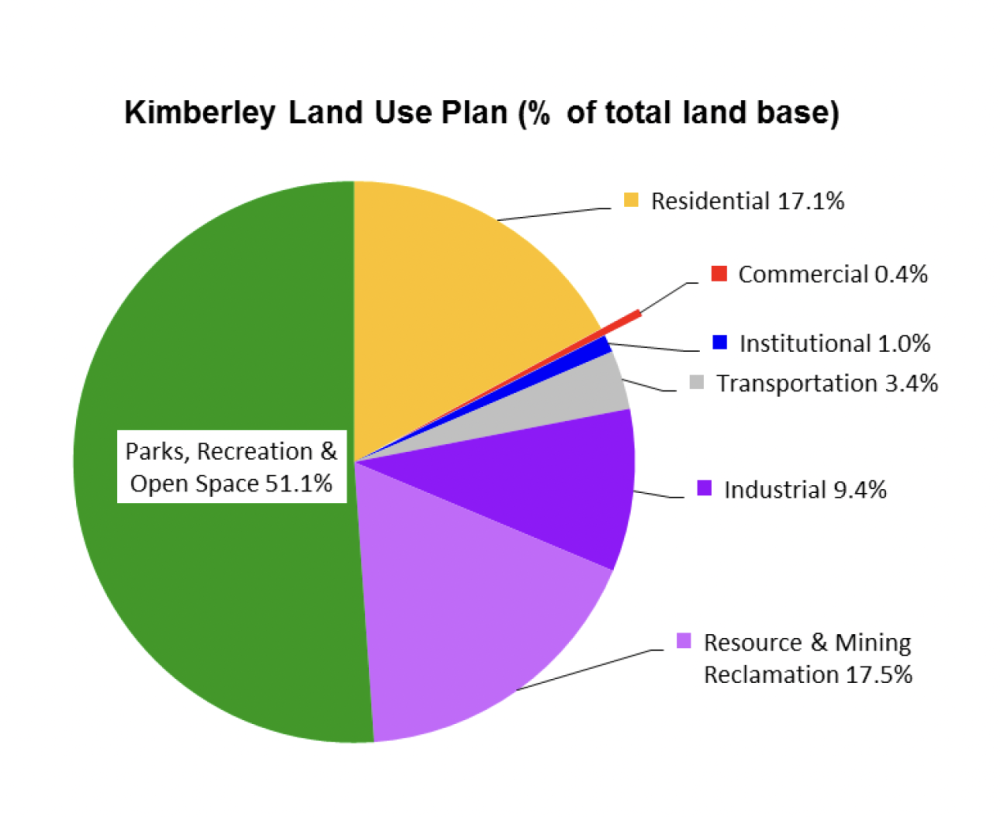
The City of Kimberley municipal boundary covers over 61km2 (more than 15,000 acres). Consistent with our community values, more than half of the land base is designated for parks, open space and recreational uses including large segments such as the Kimberley Nature Park, Kimberley Nordic Centre, three golf courses and Kimberley Alpine Resort. More than 17% of the total land base is designated for current and future residential use. Lands designated for commercial and industrial uses make up approximately 10%.
Reclaimed mining lands that are largely unavailable for redevelopment or other economically productive uses represent about 17%. Lands designated for institutional represent about 1% of the land base. Finally, nearly 3.5% of the land base is dedicated for the road transportation network and is not available for other development.
2.2 Future Growth
Kimberley has undergone several fluctuations in population over the last three decades. The population faced a -8.9% population decline between 1996 and 2006 due in large part to the closure of the Sullivan Mine in 2001. This trend has since reversed with the community growing at 8.4% or approximately 1.7% annually between 2006 and 2011, at 11.6% or approximately 2.3% annually between 2011 and 2016, and at 9.2% or approximately 1.8% annually between 2016 and 2021. The anticipated growth between 2021 and 2026, based on BC Statistics population estimates and projections is 15.4% or approximately 3.1% annually.
Based on recent trends and BC Statistics estimated 2024 population of 9018, a moderate level of annual growth of around 2% or about 3,066 people, is anticipated over the next 17 years, or to the end of the scope of this plan in 2041. An average of 84 to 98 new dwelling units per year will be needed to accommodate the anticipated population growth. Most of this residential growth can be accommodated utilizing existing infrastructure capacity in and near existing neighbourhoods through infill and redevelopment. Approximately 35% of the lands designated for future residential development are large vacant parcels that will require expansion of utilities and roads.
Although the commercial land base is relatively small, a significant portion is underutilized, unimproved or aged and in need of significant retrofit. Substantial commercial growth can be accommodated through infill and redevelopment of existing properties and would benefit from utilizing existing infrastructure capacity. Most of the land base designated for industrial is underutilized or unimproved and can accommodate significant new growth.
It should also be understood that Kimberley, as a resort community, maintains a significant number of residential properties that serve primarily recreational purposes and are only occupied seasonally. The demand for seasonal properties in Kimberley continues to grow with the current census showing the number of residential units being constructed out pacing population growth. The 2021 census revealed that 84.3% of private dwellings were occupied by their usual resident(s).* Between 2016 and 2021 the total number of dwelling units not occupied by usual residents grew, but the percentage of private dwellings that were not occupied by their usual resident(s) decreased by 2.6% from 21.2% to 18.6% (-0.5% per year) as the number of residences occupied by usual residents grew at a faster pace. This statistical change alludes to the presence of a growing ‘shadow population’ that owns recreation properties in Kimberley but are not full-time residents. The decrease in ‘shadow population’ as a percentage of all housing indicates a trend wherein tourism growth has persisted but become secondary to permanent population growth.
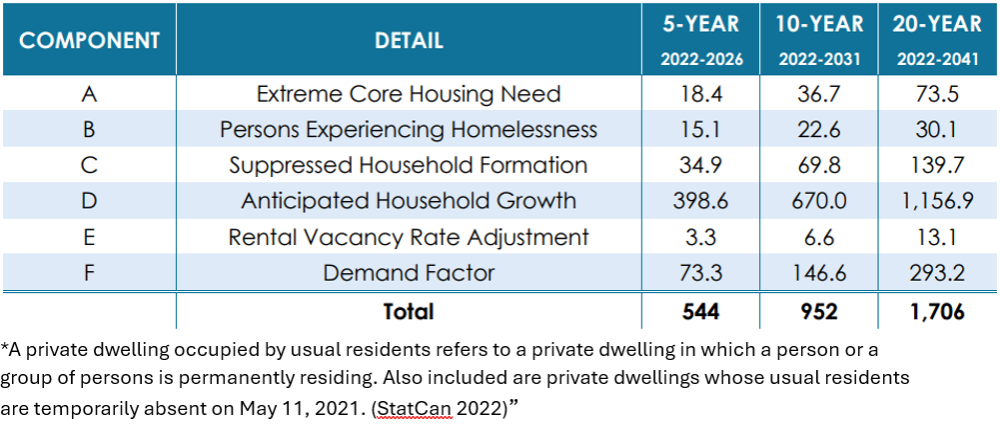
The City of Kimberley 2024 Interim Housing Needs Report provides estimated number of residential units for 5, 10 and 20 year outlooks according to meet housing needs across six core components. An update of the Housing Needs Report and Official Community Plan will be required every 5 years moving forward, ensuring accommodations are made to realize the number of units needed in both five and ten year time frames.